Wednesday, October 31, 2012

Marigolds for dia de los muertos


Happy halloween! I was hoping my marigolds would put out a big show of blooms for dia de los muertos, but they seem to be mostly done flowering for the year. They did pull off one impressive trick, though:

Marigold flowers and volunteer seedlingsTagetes patula seedling


They made babies. 

Monday, October 29, 2012

Garam masala oatmeal chocolate chip cookies

I moved the blog! Hivequeen is now Plant & Plate, at www.plantandplate.com

The full recipe for Garam Masala Oatmeal Chocolate Chip Cookies is now located at: http://www.plantandplate.com/2012/10/garam-masala-oatmeal-chocolate-chip-cookies/

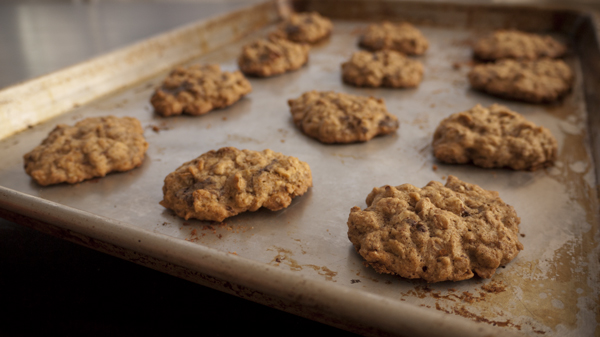
Tray of fresh-baked garam masala oatmeal chocolate chip cookies

Thursday, October 25, 2012

Search: wasp pancakes

This month's most awesome search keyword is "wasp pancakes."

I get a list of the search keywords that bring people to my blog. Most of them are the sort of thing you'd expect: "tilden park little farm," "root and stem region of pisum sativum," and variations of "dark purple tomatoes varieties." Some of them are a little stranger.

The best part is that Google's ad engine managed to come up with a product they might be interested in:


Wednesday, October 24, 2012

Why I grow cilantro


Coriander (Coriandrum sativum) seeds


People who hate cilantro really hate it. There's a genetic factor* that makes cilantro tastes soapy to some people. Even cilantro-haters have to admit one good thing about it, though: without it, we would have no coriander. Coriander is actually the dried fruit and seed of the cilantro plant (whose latin name is, tellingly, Coriandrum sativum). It's also a key ingredient in many of your favorite Indian, Middle Eastern, and North African dishes, not to mention my amazing garam masala oatmeal chocolate chip cookies.

*For geeks: There's a cluster of genes on chromosome 11 that code for olfactory receptors. One of those (OR6A2) has high binding specificity for aldehydes, which means it affects how strongly you smell a category of "smell molecules" that include the ones found in cilantro and soap. Within this cluster of genes is a single nucleotide polymorphism (SNP) — a spot where a single "letter" of DNA is different from the norm. A typo, if you will. In this case, a typo that seems to make this particular smell receptor extra-sensitive to a soapy smell molecule. For this SNP (rs72921001), people with a "C" instead of a "T" are more likely to taste cilantro as soapy, and more likely to hate cilantro. Full article at http://arxiv.org/pdf/1209.2096v1.pdf

Cilantro / Coriander (Coriandrum sativum) plant


Monday, October 22, 2012

Lemon-thyme-rosemary cake #2


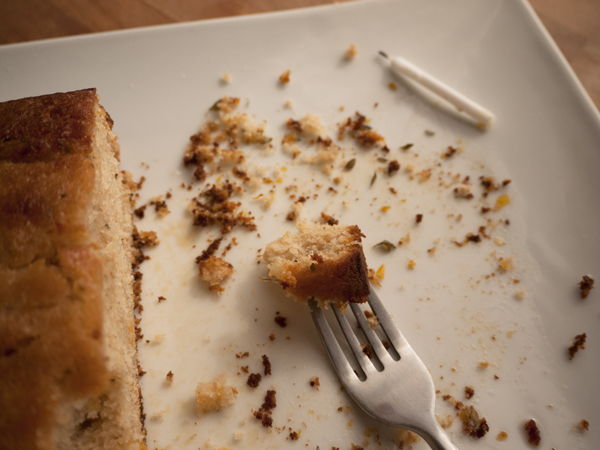
Lemon-thyme-rosemary cake


My last attempt at a lemon-herb cake was a beautiful disaster. (Full details here.) This one was a total success. It may have helped that I started with a different recipe. One without zucchini. Also, this time I remembered to add all of the ingredients before putting the cake into the oven.

You're still out of luck if you're trying to use up extra zucchini. I'll keep working on a zucchini version once they're back in season and I'm desperate for any way to use them up. On the other hand, this one will help you use up that huge bowl of lemons you have lying around — you'll need 8 or 9 of them. (If you don't have a bunch of lemons, remodel your kitchen and get Dwell or Apartment Therapy to come photograph it — stylists always seem to bring large bowls of lemons to the photo shoots).

1/3 cup of lemon zest


Friday, October 19, 2012

Food: An Atlas

Update: the project reached its goal and will be funded and printed! They're now working towards stretch goals increase the print run. 

I pretty much had to sign on as a backer of Food: An Atlas. It combines so many things that I love: food, information graphics, alternative publishing models, local independent organizations ... oh, and the cover and book design are by one of my local independent designer friends (queridomundo.com).

And come on: it's got a map of America's "Beershed" (the sources of the ingredients that go into beer). Which reminds me: if you're local and homebrewing, let me know — I want to come over and take pictures.
America's Beershed. From Food: An Atlas via Edible Geography


From the project's Kickstarter page:
"Food: An Atlas is a collection of over 60 maps (and growing!) cooperatively-created by the guerrilla cartography community.... Dealing with subjects as varied as global cropland distribution, Los Angeles’s historic agrarian landscape, community supported fisheries in Massachusetts, the redistribution of food surpluses in Italy, and Taco Trucks of East Oakland, its chapters focus on food productionfood distributionfood security and cuisine."
Map section: Urban Agriculture Projects in San Francisco. From Food: An Atlas via Kickstarter.com


The Kickstarter campaign ends on Tuesday, and the project has almost reached its goal. (For those unfamiliar with Kickstarter: it's a way to crowdsource project funding. Like PBS, you generally get a thank-you at each pledge level, plus the warm fuzzy feeling of making something awesome happen. Unlike PBS, it's all-or-nothing: if the project reaches its funding goal by the deadline it sets, your credit card gets charged at that time; if it doesn't reach the goal, one gets charged.)

A $10 pledge gets you a digital copy of the book (and your location gets added to the collaborators map in the atlas itself); a $25 pledge gets you that plus a copy of the printed book (estimated delivery in December). The money goes to cover the printing costs, and any profit gets donated to a food justice organization. (The collaborators are all donating their time.) Read more about the project on its Kickstarter page: http://www.kickstarter.com/projects/1276177353/food-an-atlas-0


Wednesday, October 17, 2012

Bee talk this Thursday, Oct 18

Want to learn more about native bees? Professor Gordon Frankie will be giving a talk this Thursday in Berkeley about the relationship between native bees and native flowers, and how to plan a bee-friendly native garden. If you can't make it, visit his group's website and guide to bee-friendly gardening at helpabee.org.

The talk is sponsored by the Golden Gate Audubon Society: more details at goldengateaudubon.org/education/speaker-series/.

Thursday, October 18, 
7 pm refreshments, 7:30 program

at Northbrae Community Church
941 The Alameda (btw Solano and Marin)

Free for GGAS members, $5 for nonmembers.